Steam and the machine
The Big Picture

All over Europe thr greatest minds in a variety of disciplines were finding ways to integrate Chess with thier studies. In the early 1780s Wolfgang Von Kempleman, engineering expert of the Hapsburg Empire’s imperial seat in Vienna, designed the world’s first chess playing machine, the famed Turk. The Turk was an ingenious display of Von Kempleman’s machining skills. The lifesized figure could move its mechanical arm, grasp a piece, and place it on the square of its choosing, an awe-inspiring spectacle in and of itself. Even more impressive was Von Kemplemen’s construction beneath the board, a concealed compartment where a hidden player could play the game for the machine using a clever magnetic system to reveal the moves being played above, he rarely lost. The Turk toured the world becoming a huge sensation,beating eminent world figures including Napoleon Bonaparte; many guessed, but few figured out the secret of the so called thinking machine. As we will see later, the Turk would have a greater impact on the evolution of technology than anyone coud have imagined at the time.
Although we dont’ know where the match between the Turk and Napoleon took place it might as well have happened at the Cafe de la Regence. The undisputed master of his time Philidor died in 1795, in exile in London. However after the upheaval of the French Revolution the Cafe reemerged as one of the epicenters of Parisian life and world chess. Philidore was succeeded in Europe by players like Deschapelles, La Bourdonnais and Adolf Andersen, Blackburne, Saint-Amant and Howard Staunton. When Staunton defeated Saint Amant in 1843 11-6-4 (although Amant had lost the first six matches and dominated the latter half of the contest) he dubbed himself world champion; this sentiment, however, was not shared by the rest of the world.
Staunton’s brash, abrassive, and self-aggrandizing nature did not win him many friends in the chess world. A noted Shakespearian actor and scholar, though he may not have been the strongest player of the time he was its most forceful personality. The tournament he held at England’s 1851 “Great Exhibition of Art and Industry” was, although snubbed by many of Europe’s top players, the first of its kind. Staunton was knocked out in the third round by Adolf Anderssen (whose game against Kieseritzky has been dubbed the immortal game), a disappointing showing. Staunton’s greatest influence in the world of Chess, has been the lending of his name to Nathaniel Cook’s 1849 design of a chess set. Known throughout the world as the Staunton Chessmen, it is this design that is commonly used in tournaments, and is considered as standard by chess aficionados across the globe.
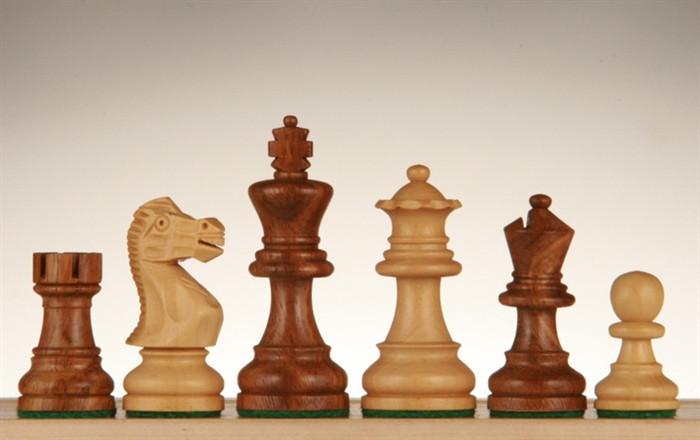
The Staunton Chessmen
60 years after the death of Philidor the Cafe de La Regence was taken storm by another prodigy. At age nine Paul Morphy, watching a game between his father and uncle, surprised both men when, after they had abandoned the game as a draw, Paul exclaimed that his father should have won the game. He then proceeded to reset the position, and play out the winning combination. Shocked, Morphy’s father began teaching the game to his son, and as the child’s knowledge quickly outpaced his own, sought out qualified instruction for the boy. Morphy’s father however took care not to neglect his son’s overall education, and Morphy who trained to be a lawyer in South Carolina, was only allowed to study Chess when on break at home in New Orleans. By the age of twenty Morphy was fluent in four languages, and could recite the entire Civil Code of Louisiana from memory. That same year he won the American Chess Congress Championship, and after receiving backing of $5,000 from the New Orleans Chess Club departed for Europe to take on the best in the world.
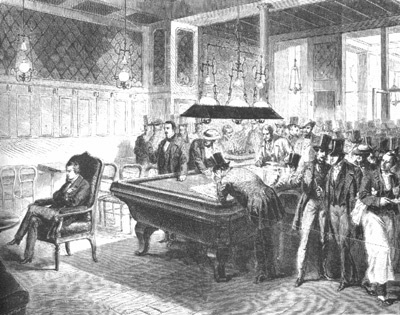
A blindfold chess exhibition by Paul Morphy’s at the Cafe de la Regence
Paris was taken aback by the young genius, much as the young genius was taken aback by Paris. Morphy lost his first two games against the Cafe’s top player of the day, Daniel Harrwitz, after staying out all night enjoying the Parisian nightlife. After his second victory Harrwitz, vainly, poked fun at Morphy’s sickly pallor, to which Morphy responded to his ‘second’, “How astonished all these men will be (gesturing to the large crowds watching the matches at the Cafe) when Harrwitz does not get another game.” True to his word Morphy dominated Harrwitz to such an extent that the latter would appear visibly sick across the board from Morphy, shaking violently when he reached to make a move. Morphy dominated all of Europe’s best players except Howard Staunton, who living up to his despicable reputation used every excuse and evasion possible to avoid a match. Staunton’s refusal to play him infuriated Morphy who returned to America to pursue his legal practice, retiring from Chess,. This was to have tragic consequences for Morphy who, after having tasted the pleasures of the Parisian nightlife, never successfully reintegrated into life in The States.
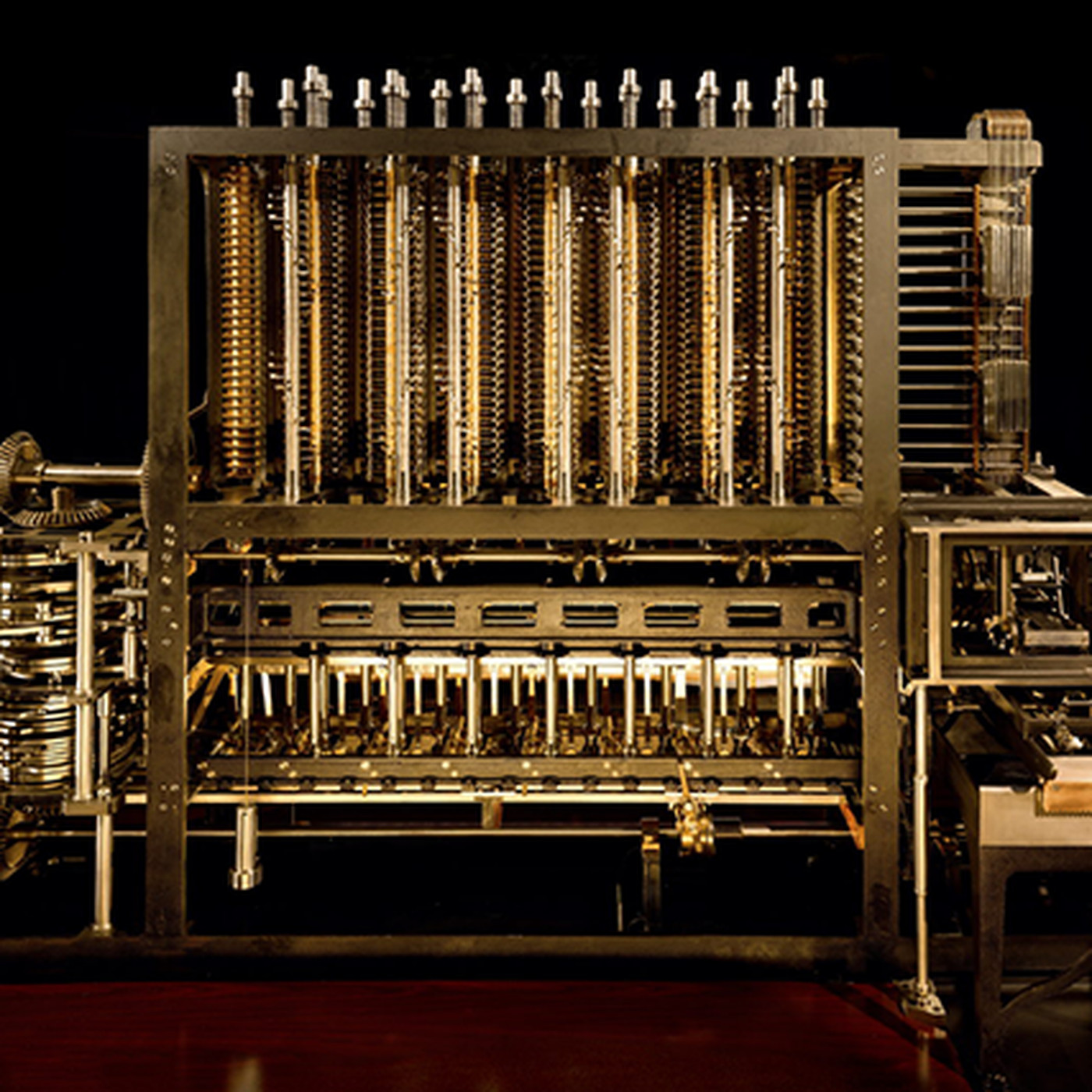
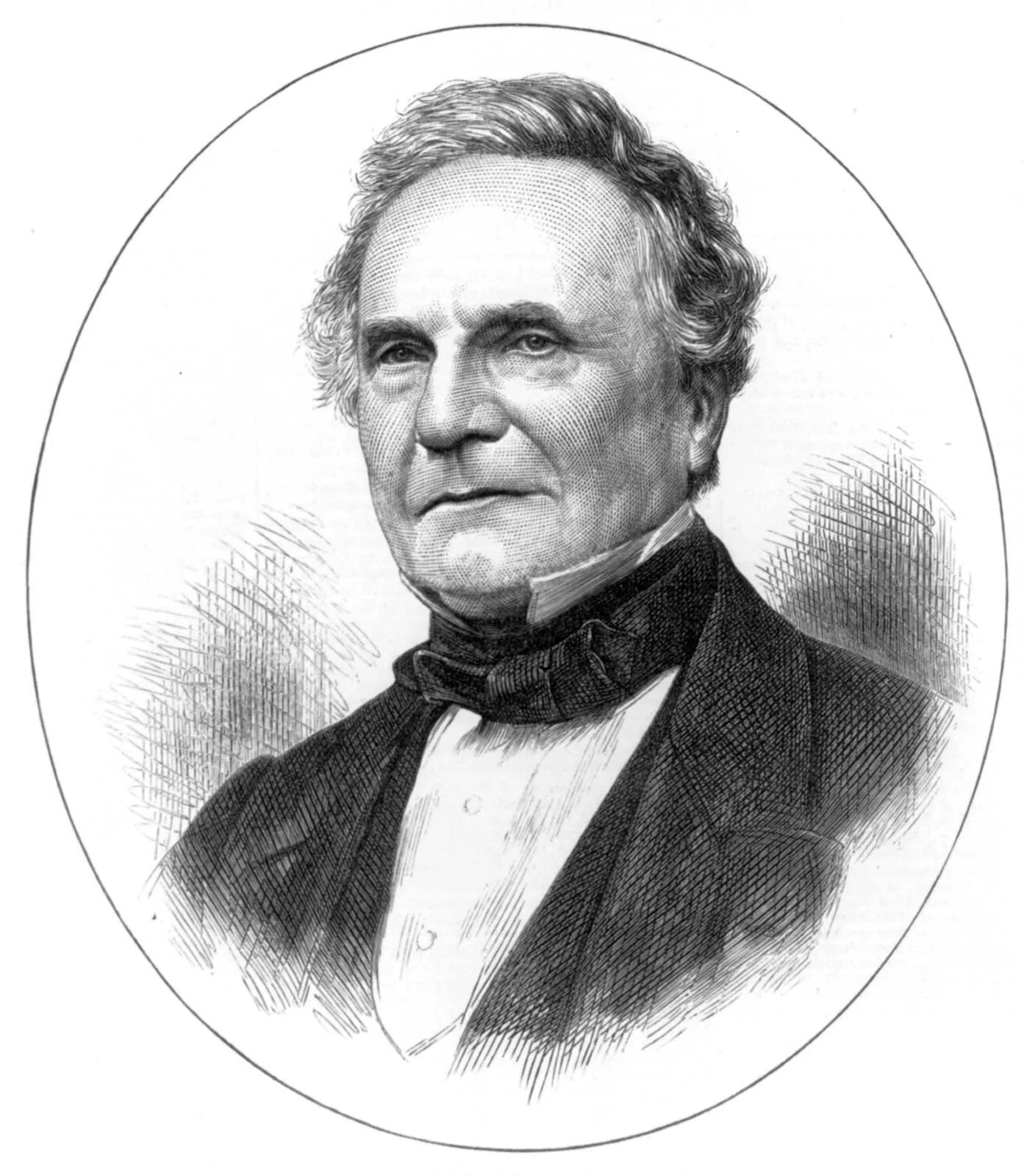
While The Turk’s famous illusion was designed as an amusement, it ironically may have played a far more important purpose. In so successfully tricking so many people into believing that it truly was a thinking machine it planted the idea that one could actually be designed and built. In the mid 1820s renowned British mathematician, philosopher, and socialite Charles Babbage, who had twice lost games to the Turk, drew up the schematics for building such a device. In that era, teams of mathematicians and volumes of mathematical tables were necessary to conduct the high level mathematical calculations, these teams of people were called computers. In 1821 Babbage designed his Difference Engine as a means of replacing those teams with a mechanical computer, thus speeding up the process of calculation and eliminating human error. A decade later, with the Difference Engine still incomplete, he designed the Analytic Engine, a machine that could simultaneously perform multiple mathematical functions, and could be ‘reprogrammed’ any number of times to perform different problems, just as a modern computer does.
The First Industrial Revolution
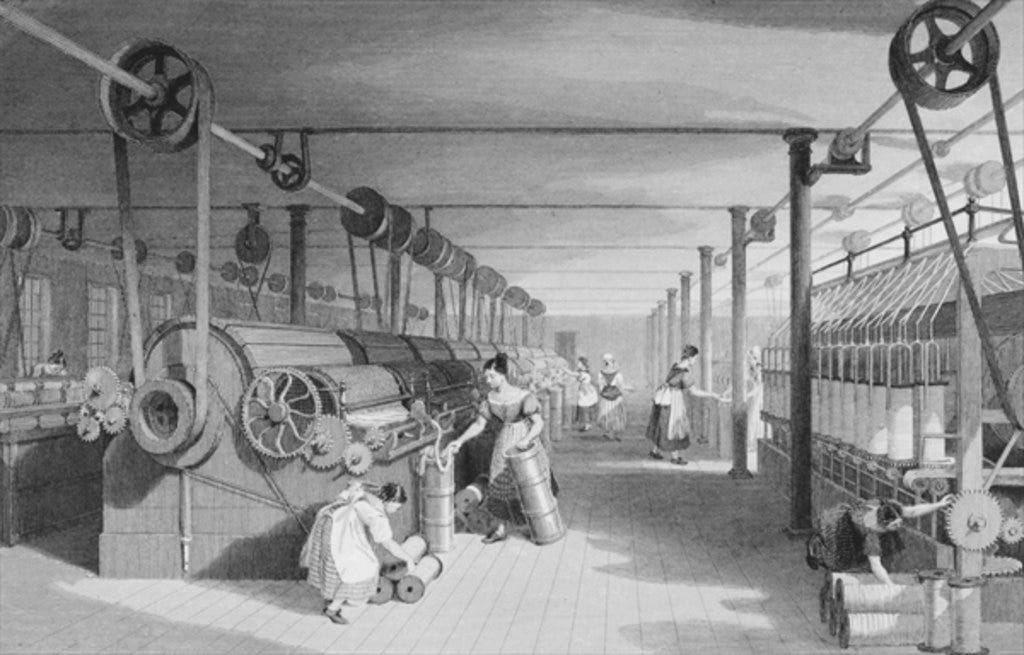
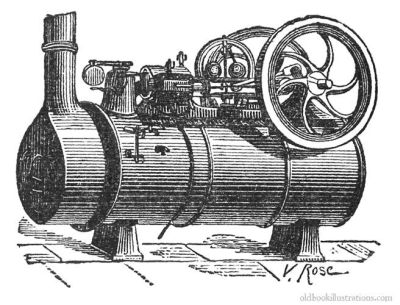
The first Industrial Revolution, spanning the late 18th to early 19th century, marked a transformative era of technological innovation. Originating in Britain, key inventions like the steam engine, spinning jenny, and power loom revolutionized manufacturing, transitioning from hand production to mechanized processes. The rise of factories centralized production, drastically altering the workforce as people migrated to urban areas for jobs. Concurrently, improvements in transportation, especially railways and canals, facilitated faster movement of goods and people. These technological shifts profoundly changed societal structures, ushering in increased production, urbanization, and new economic and social dynamics.
A series of groundbreaking discoveries in the 19th century illustrated the laws of electromagnetism, a fundamental force governing countless phenomena in our universe. These discoveries fueled innovations in communication and power generation, complementing the mechanical advances of the First Industrial Revolution.
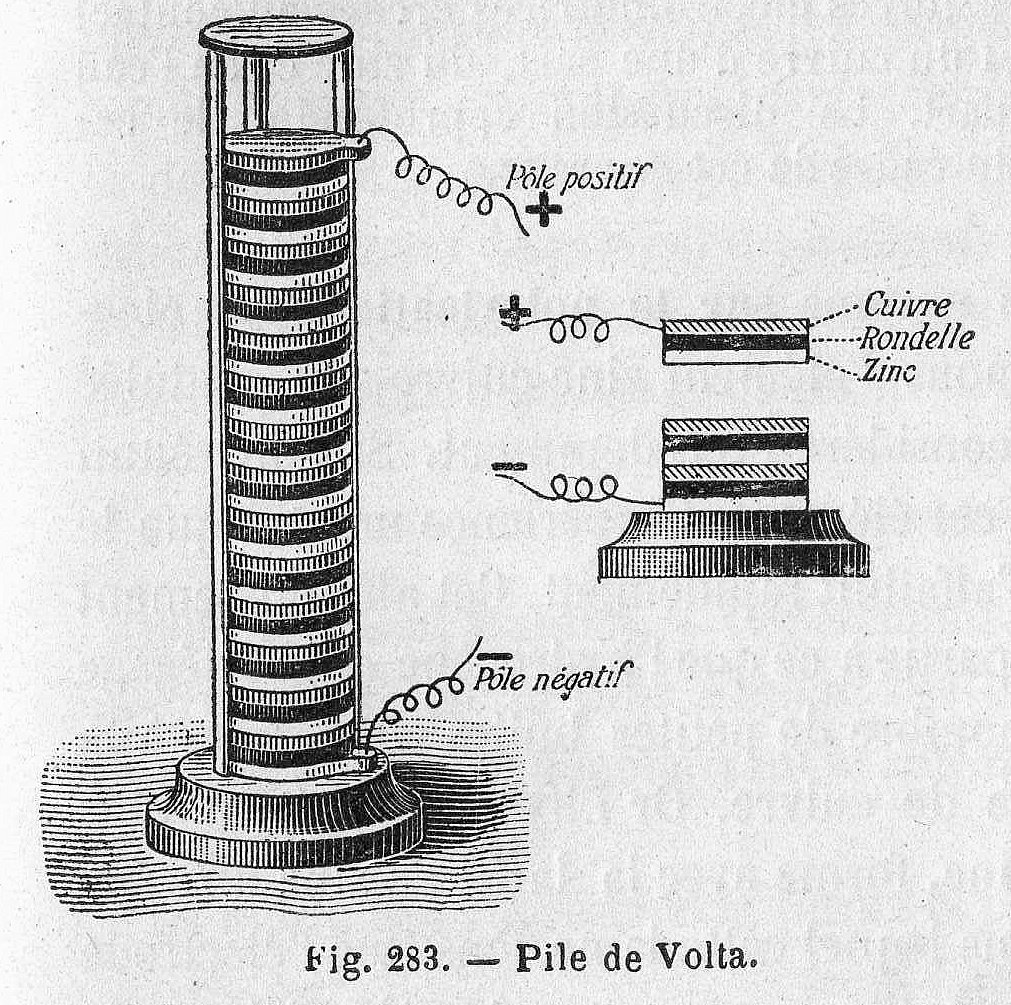
In the late 18th century, Luigi Galvani’s investigations into bioelectricity ,which he termed animal electricity, laid the foundation. However it was Alessandro Volta’s invention of the voltaic pile, the first chemical battery, that proved electric currents could be sustained and not just short-lived sparks. While Volta gave us the first steady source of current, Charles-Augustin de Coulomb elucidated the laws governing electric charge, defining the nature of electric force between charged entities.
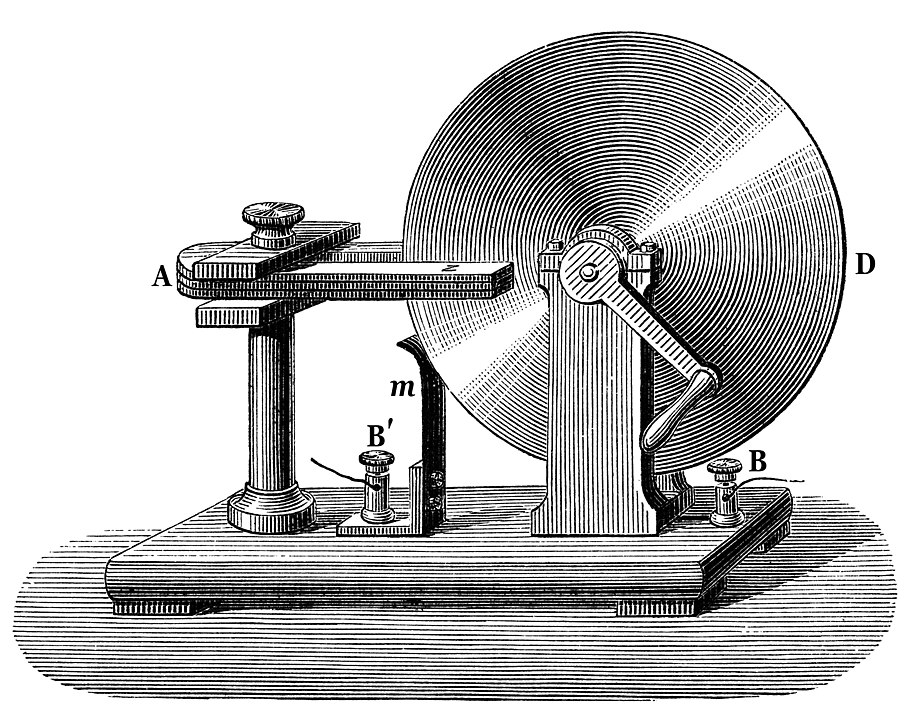
It was the early 19th century that truly electrified our understanding when self-made scientist Michael Faraday, with his principle of electromagnetic induction, showcased how a changing magnetic field could produce an electric current, and an that an electrical current could produce magnetic movement. André-Marie Ampère further refined the domain with Ampère’s Law, which relates the circulating magnetic field in closed loops to the current passing through the loop.
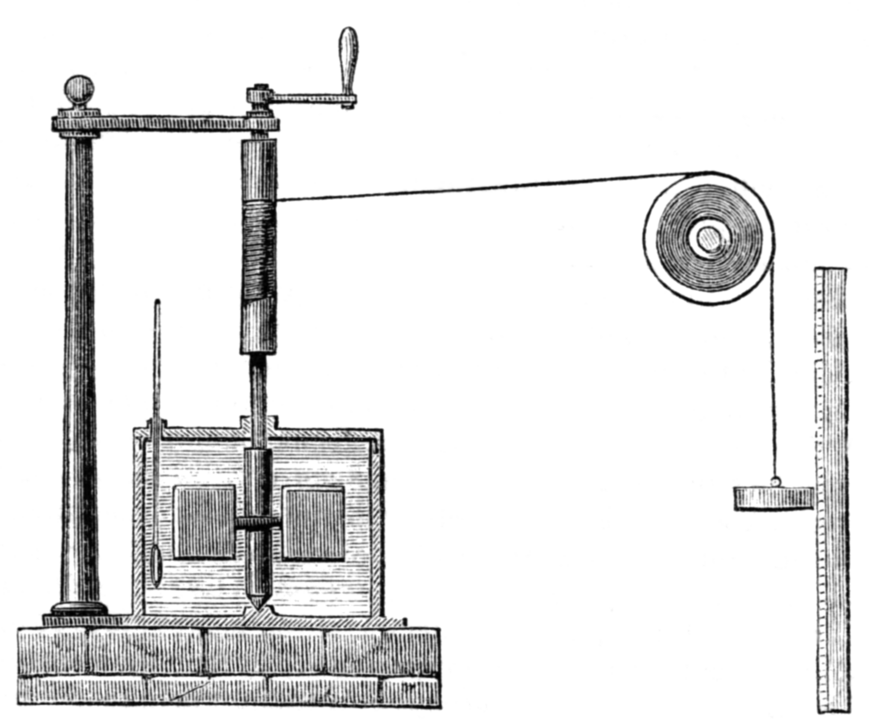
Georg Simon Ohm introduced the concept of resistance in a conductor, encapsulating it beautifully in Ohm’s Law, stating the proportionality of current and voltage in a resistor. James Watt, primarily known for his steam engine innovations, also lent his name to the unit of power, making our understanding of electrical power quantifiable. James Joule’s studies then connected the realms of electricity and thermodynamics, underscoring the relationship between electric energy and heat.
Meanwhile, the mathematical prowess of Joseph Fourier enhanced our understanding of heat flow and waveform analysis, with Fourier transforms becoming indispensable in fields ranging from signal processing to quantum physics. Heinrich Hertz’s experiments validated the existence of electromagnetic waves, and finally, the unit of frequency was named in his honor.
Elucidating the laws of Electromagnetism, has proven pivotal to humanity’s technological advancement. The synergistic blend of experimental observations and theoretical formulations has not only demystified the unseen forces and fields but also paved the way for inventions that define modern life.
Pioneers of Power
5.2.1 The Laws of Electromagnetism
Coulomb’s Law
Coulomb’s Lawdescribes the force between two stationary electrically charged particles. It states:
The force (\( F \)) between two point charges is directly proportional to the product of the magnitudes of the charges (\( q_1 \) and \( q_2 \)) and inversely proportional to the square of the distance (\( r \)) between their centers.
Mathematically, Coulomb’s Law is represented as:
\[ F = k_e \frac{|q_1 q_2|}{r^2} \]
Where:
– \( F \) is the magnitude of the electrostatic force between the charges.
– \( q_1 \) and \( q_2 \) are the charges.
– \( r \) is the distance between the centers of the two charges.
– \( k_e \) is Coulomb’s constant, approximately equal to \( 8.9875 \times 10^9 \, \text{N m}^2/\text{C}^2 \) in vacuum.
The force is attractive if the charges have opposite signs and repulsive if the charges have the same sign.
Coulomb’s Law is foundational in electromagnetism and has been instrumental in developing the theory of electrostatics. It’s analogous to Newton’s law of universal gravitation, but for electrical charges instead of masses.
Faraday’s Law of Electromagnetic Induction
Faraday’s Law of Electromagnetic Induction often simply referred to as Faraday’s Law, is a fundamental principle in electromagnetism. It describes how a change in the magnetic environment of a coil of wire induces an electromotive force (EMF) in the wire. Essentially, it explains how we can generate an electric voltage by changing a magnetic field.
Here’s the basic statement of Faraday’s Law:
The induced electromotive force (EMF) in any closed circuit is equal to the negative rate of change of the magnetic flux through the circuit.
Mathematically, this can be expressed as:
\[ \mathcal{E} = -\frac{d\Phi_B}{dt} \]
Where:
– \( \mathcal{E} \) is the induced EMF (voltage).
– \( \Phi_B \) represents the magnetic flux (the product of the magnetic field \( B \) and the area \( A \) it penetrates, and the cosine of the angle between the magnetic field lines and the normal (perpendicular) to the surface).
– \( \frac{d\Phi_B}{dt} \) is the rate of change of this magnetic flux with respect to time.
Ohm’s Law
Ohm’s Law states that the current (\(I\)) flowing through a conductor between two points is directly proportional to the voltage (\(V\)) across the two points, provided the temperature remains constant. It is mathematically represented as:
\[ V = I \times R \]
Where:
– \(V\) is the voltage across the conductor (measured in volts, V).
– \(I\) is the current flowing through the conductor (measured in amperes, A or amps).
– \(R\) is the resistance of the conductor (measured in ohms, \(\Omega\)).
Ohm’s Law is a fundamental relationship used in electrical engineering and physics to relate voltage, current, and resistance in an electrical circuit.
Ampère’s Law
Ampère’s Law is a fundamental principle in electromagnetism that relates the circulating magnetic field in a closed loop to the electric current passing through the loop. It’s one of Maxwell’s equations, which are the four fundamental equations describing classical electromagnetism.
Here’s the basic statement of Ampère’s Law:
The magnetic field \( \mathbf{B} \) integrated around a closed loop is equal to the permeability of free space \( \mu_0 \) times the electric current \( I \) passing through the area bounded by that loop.
Mathematically, this is expressed as:
\[ \oint \mathbf{B} \cdot d\mathbf{l} = \mu_0 \times I \]
Where:
– \( \oint \) represents a closed line integral around a loop.
– \( \mathbf{B} \) is the magnetic field.
– \( d\mathbf{l} \) is a differential length element along the loop.
– \( \mu_0 \) is the permeability of free space (approximately \( 4\pi \times 10^{-7} \, \text{T m/A} \)).
– \( I \) is the current passing through the area enclosed by the loop.
The story of Charles Babbage and Ada Lovelace intertwines the fields of mathematics, engineering, and the nascent world of computation.
Charles Babbage’s Engines
Difference Engine: Babbage conceptualized the Difference Engine in the early 1820s. It was intended to automate the process of producing mathematical tables, which were vital for navigation, engineering, and other fields. These tables were traditionally calculated manually, which led to errors. The Difference Engine was designed to compute these tables using the method of finite differences, which could, in principle, produce any polynomial function.
However, due to funding issues, disputes with craftsmen, and Babbage’s evolving vision, a complete Difference Engine was never built in Babbage’s lifetime. A portion of the engine he did manage to get built is now at the Science Museum in London.
Analytical Engine: While the Difference Engine was revolutionary in its own right, Babbage’s vision for the Analytical Engine was even more ambitious. Conceived in the 1830s, this machine was intended to be programmable using punched cards, a method inspired by the Jacquard loom. The Analytical Engine was designed with an “Arithmetic Logic Unit,” control flow in the form of conditional branching and loops, and integrated memory—essentially, the major components of a modern computer.
Unfortunately, like the Difference Engine, the Analytical Engine was also never fully built during Babbage’s lifetime. The reasons were manifold, including the complexity of the machine, funding shortages, and again, Babbage’s perfectionism and evolving designs.
Ada Lovelace’s Contribution
Ada Lovelace, the daughter of the poet Lord Byron and mathematician Annabella Milbanke, met Babbage in 1833. By 1843, she had translated an article by the Italian mathematician Luigi Federico Menabrea about the Analytical Engine. But more than just translating, Lovelace added her own notes, which ended up being more extensive than the original article.
In her notes:
Algorithm Design: Lovelace provided an elaborate algorithm intended for implementation on the machine—a method for the Analytical Engine to compute Bernoulli numbers. This is considered the world’s first published algorithm intended for computer execution, earning her recognition as the world’s first computer programmer.
Vision of Computing: Beyond the algorithm, Lovelace’s notes are significant for their foresight about what such machines might accomplish. She mused that the Analytical Engine “might act upon other things besides number,” suggesting it could be used to create music or art, essentially predicting the future multifunctionality of computers.
Lovelace’s insights were not about the machine’s technical details but about its potential, its broader implications. She saw the Analytical Engine as something more than a mathematical tool; she realized it had potential as a general-purpose device.
In summary, while Babbage conceived and designed revolutionary machines for his time, Ada Lovelace recognized their full potential, laying down ideas that are fundamental to our current understanding of what computers can achieve. Their combined legacies form the bedrock on which the edifice of modern computing has been built.
Dreams of a Thinking Machine; The Invention of a Mechanical Computer
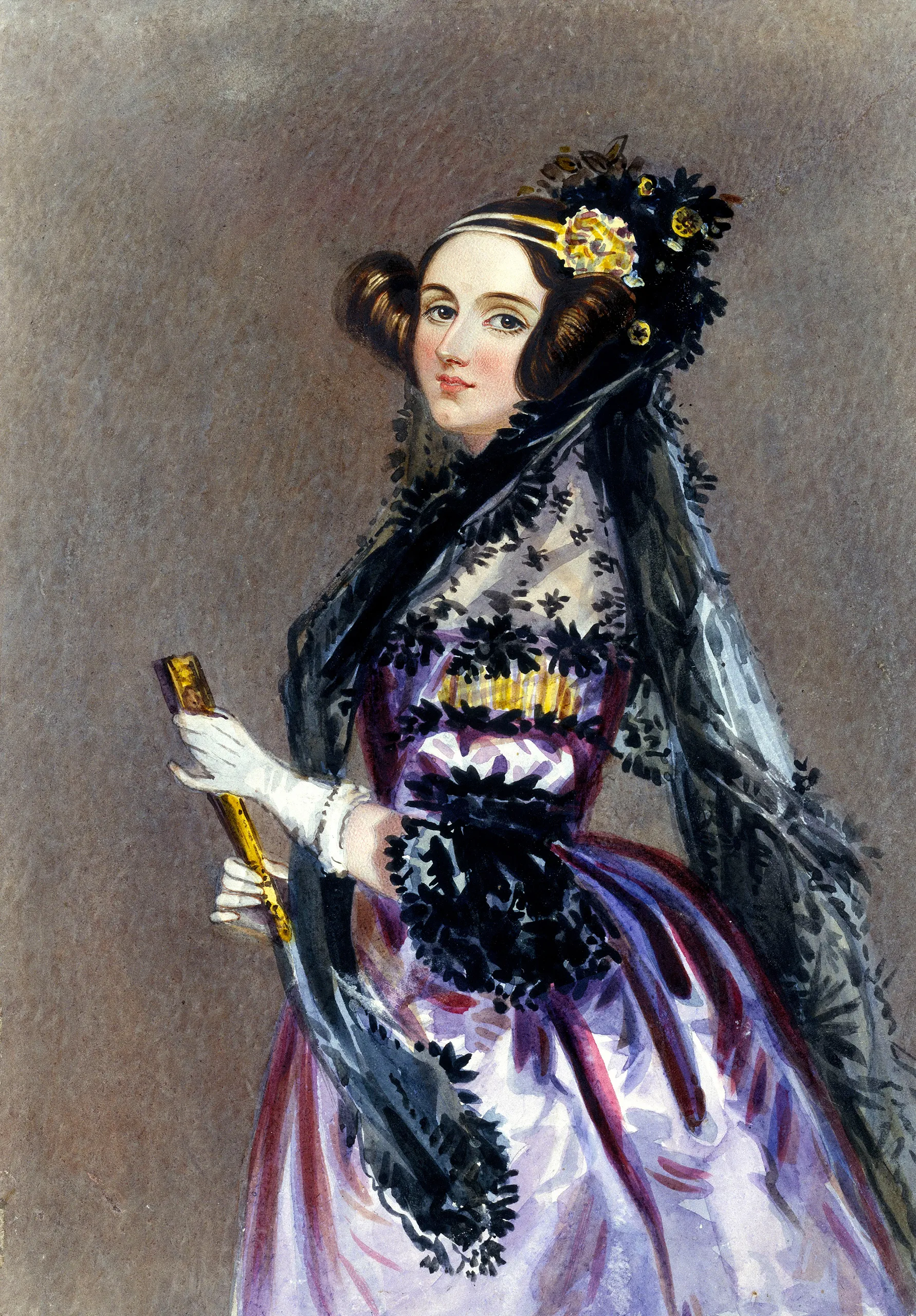
In 2013 The New Yorker ran an article entitled Ada Lovelace, the first tech visionary

Through the Looking Glass
In Lewis Carroll’s “Through the Looking-Glass,” chess plays a central role, echoing the book’s themes of strategy, transformation, and the journey from innocence to experience. The narrative’s structure follows Alice’s progression from a humble pawn to a queen, mirroring the moves of a chess game. Each of the main characters she meets corresponds to a piece on the chessboard, and their movements and interactions are laden with the rules of the game. Furthermore, Carroll integrates logic puzzles, some of which are direct challenges to the reader, reflecting his own background as a mathematician and logician. These puzzles serve not only as entertaining diversions but also as critiques of the sometimes absurd and arbitrary nature of adult rules and the challenges of growing up. At the time of its publication, during the Victorian era, there was a cultural fascination with games, puzzles, and logical challenges, making the motif timely and resonant. Historically, “Through the Looking-Glass” has been viewed as an exploration of the complexities of childhood and the inevitable transition to adulthood. The chess motif, coupled with the logic puzzles, embodies the strategic maneuvers and challenges one faces in life’s journey.
Philosophy
The Romantic Era
Positivism
August Comte
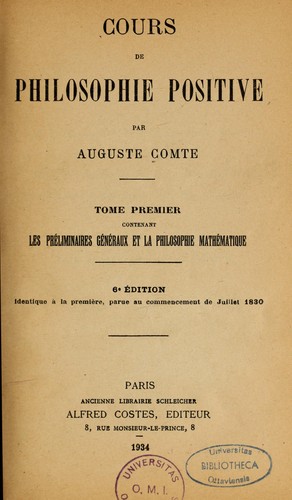
Auguste Comte, the father of positivism, advocated for the application of the scientific method to study and understand society. He believed human understanding evolved in three stages: theological, metaphysical, and scientific (or positive). In this final stage, empirical observations and logic prevail. Comte’s philosophy underscored the potential of science to progress society, laying groundwork for modern sociology and the philosophy of science.
Utilitarianism
JS Mill
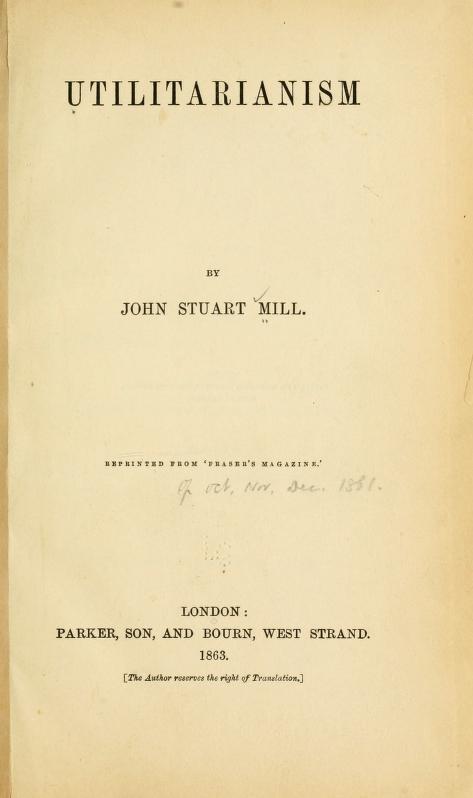
John Stuart Mill, a seminal proponent of utilitarianism, advanced the principle that actions are right if they promote the greatest happiness for the greatest number. Emphasizing utility as the ultimate measure of morality, He fervently advocated for individual liberty, emphasizing freedom of thought and expression. Mill’s “On Liberty” remains a foundational text on personal rights and the limits of state intervention. His work “Utilitarianism” provides a detailed exploration of this ethical framework, profoundly influencing subsequent moral philosophy.
Dialectical Idealism
GW Hegel
Georg Wilhelm Friedrich Hegel was instrumental in developing dialectical idealism, where ideas evolve through a thesis-antithesis-synthesis process. He also examined the stages of consciousness; positing that history and reality unfold in a rational manner, culminating in absolute knowledge and freedom. Hegel’s intricate system reshaped philosophical thought, laying foundational ideas for German idealism, existentialism, Marxism, and contemporary continental philosophy.
Pure Mathematics
George Boole
George Boole (1815-1864) was an English mathematician and logician who pioneered the field of mathematical logic. His groundbreaking work, “The Laws of Thought,” introduced what is now known as Boolean algebra, a system of logic that laid the foundations for the digital age. By representing logical statements with algebraic equations, Boole transformed the way we understand logic and provided the essential groundwork for modern computer science. His innovative approach has had a profound and lasting impact on technology, philosophy, and mathematics.
5.2.1 Hegel
Hegel’s thought presents a sophisticated interplay between dialectical idealism and the phenomenology of history. Understanding this connection is key to grasping his broader philosophical project.
Dialectical Idealism
At the core of Hegel’s dialectical idealism is the belief that reality is fundamentally rational. The true nature of reality, for Hegel, is the self-developing idea or concept (Begriff). Reality unfolds and evolves through a series of contradictions and resolutions, a process known as the dialectic. This dialectical process involves the movement from a thesis to its antithesis, culminating in a synthesis. This synthesis then becomes a new thesis, and the process repeats. Through this movement, the concept progresses towards greater self-realization and freedom.
Phenomenology of History
Hegel posited that history is not a random sequence of events but a rational process. The World Spirit (Weltgeist) actualizes itself over time, realizing its freedom through the unfolding of historical epochs. Thus each historical period represents a certain stage of human consciousness and freedom. A period emerges as a thesis, confronts internal contradictions (antithesis), leading to a transformation or transition to a new stage (synthesis). This pattern is evident in his analysis of epochs like the Oriental, Greek, and Roman worlds and their transition to Christian-modern Europe.
In Hegel’s “Phenomenology of Spirit,” the journey of Spirit is, in essence, the journey of consciousness coming to recognize itself. History, in this sense, is a record of this self-recognition, where Spirit understands its essence over time. Dialectical idealism becomes manifest in history. The ideas or concepts that evolve dialectically in thought find their realization in historical processes. For example, the concept of freedom, central to Hegelian philosophy, is actualized in various forms throughout history, from the freedom of the polis in Ancient Greece to the individual freedom in modern states. While history might seem chaotic, Hegel believed that it tends towards greater freedom and rationality. The dialectical tensions within each epoch push humanity forward, making the arc of history a phenomenological realization of dialectical idealism.
In summary, for Hegel, the abstract processes of dialectical idealism and the concrete unfolding of history are two sides of the same coin. History is the stage where the dialectical development of ideas is enacted, leading to the self-realization of Spirit and the actualization of human freedom. The phenomenology of history, therefore, offers a tangible account of the abstract movements of dialectical idealism.
5.2.1 John Stuart mill
John Stuart Mill’s (1806-1873) contributions span across ethics, political theory, economics, and the philosophy of science.
Utilitarianism
Mill is best known for refining and promoting the ethical theory of utilitarianism, which posits that actions are right in proportion as they tend to promote happiness and wrong as they tend to produce the reverse of happiness. Happiness, for Mill, meant pleasure and the absence of pain. In his essay “Utilitarianism” (1861), he defended this principle against common criticisms and misunderstandings. Mill was not the originator of utilitarianism. The philosophy has its roots in the works of Jeremy Bentham, who formulated its main tenets. Bentham posited that actions should be judged by their consequences, specifically by their capacity to increase pleasure or decrease pain, which he termed the “principle of utility.” W
hile Mill adopted the foundational principles of utilitarianism from Bentham, he introduced significant refinements. Bentham had proposed a kind of “hedonic calculus,” suggesting that pleasures and pains could be quantitatively measured and compared. Mill, however, distinguished between higher and lower pleasures. He argued that intellectual and moral pleasures (like reading a book or enjoying a piece of music) are intrinsically more valuable than mere physical pleasures. As he famously said, “It is better to be a human being dissatisfied than a pig satisfied; better to be Socrates dissatisfied than a fool satisfied.”
Daniel Bernoulli’s concept of utility in the context of economics and probability is a precursor to the more general philosophical concept of utility in utilitarianism. Bernoulli introduced the idea to solve the St. Petersburg paradox in probability theory. He proposed that individuals do not derive linear utility from wealth, but rather the utility they derive from wealth is a logarithmic function. While there’s a conceptual overlap between Bernoulli’s idea and utilitarianism, in that both involve maximizing some form of utility, the specific contexts are different. Bernoulli was addressing a problem in probability and economics, while Bentham and Mill were concerned with ethics and societal welfare.
Liberty
Mill’s essay “On Liberty” (1859) is a vigorous defense of individual freedom in the face of state and societal interference. He famously posited the “harm principle”, stating that individuals should be free to act as they wish, unless their actions harm others. Mill was a firm believer in representative democracy. In “Considerations on Representative Government” (1861), he discussed various forms of representation and advocated for a system that was inclusive and that would represent minority voices, not just the majority. He introduced the idea of “proportional representation” and was also a proponent of extending suffrage, though he believed in weighted voting based on education. In “The Subjection of Women” (1869), Mill advocated for gender equality, arguing against the social and legal hindrances that suppressed women’s potential and claiming that both society and individuals would benefit from emancipation and equality of the sexes.
Political Economy
Mill’s “Principles of Political Economy” (1848) is one of the most important texts in the history of economic thought. Mill recognized the dynamic nature of the economy and sought a middle ground between unregulated laissez-faire capitalism and socialism. He defended private property and free markets but also argued for income redistribution to mitigate the worst effects of economic inequality.
Mill staunchly believed that freedom of thought and discussion was essential for societal progress. He felt that without an open marketplace of ideas, society couldn’t evaluate and adopt the best beliefs and practices.
In essence, John Stuart Mill’s philosophy and political-economic thought were deeply rooted in the principles of individual liberty, the pursuit of happiness, and the importance of rationality and open discussion. His balanced approach to economics sought to combine the best elements of capitalism and social welfare. Through his writings, Mill has left a lasting legacy, shaping modern liberal and libertarian thought, feminism, and economic theories.
5.2.1 August Comte
Auguste Comte (1798-1857), a French philosopher, is best known for founding positivism—a philosophy that emphasizes empirical and scientific methods of inquiry. His work significantly shaped the evolution of the philosophy of science, especially in the 19th century.
At the heart of Comte’s philosophy is positivism, which posits that knowledge should be derived from empirical and observational data, as opposed to metaphysical or theological speculations. Comte believed that only through scientific methods could we achieve reliable knowledge. Comte proposed that human societies progress through three stages of development in their quest for understanding:
- 1. Theological Stage: In this earliest phase, phenomena are explained through supernatural or divine intervention.
2. Metaphysical Stage: Explanations begin to shift towards abstract and speculative causes rather than divine ones.
3. Positive (or Scientific) Stage: In this final stage, which Comte believed modern society was entering, explanations are rooted in scientific observation and empirical methods.
Comte delineated a hierarchy of sciences, beginning with mathematics (the most abstract and general) and culminating in sociology (the most concrete and specific). Each science, from mathematics to physics to chemistry and finally to sociology, lays the foundation for the next, with each subsequent science being more complex. Comte is often credited with coining the term “sociology.” He saw sociology as the culmination of all sciences, one that would bring together principles from all the preceding fields to understand and organize human society effectively.
Comte was critical of introspection and believed that mental events could only be understood scientifically through objective observation of behaviors and external manifestations. Comte’s emphasis on empiricism, observation, and his push to apply scientific methods to all areas of inquiry laid the groundwork for the development of the philosophy of science. His work instilled a sense of rigorous methodology and the belief that scientific inquiry could be applied not only to the natural world but also to the study of human society.
5.2.1 George Boole
George Boole (1815-1864), an English mathematician and logician, is renowned for his work in the domain of mathematical logic and the development of Boolean algebra, a field of mathematics which played a foundational role in modern computer science and digital circuit design.
Boole’s initial foray into the world of mathematical logic came with his work “The Mathematical Analysis of Logic” (1847). However, it was his subsequent publication, “An Investigation of the Laws of Thought” (1854), that fully expounded on what would later become known as Boolean algebra.
Symbolic Operators in Boolean Algebra
Boole’s algebra was revolutionary because it presented logical operations using symbols, a method not restricted to mere numerical values. The primary symbols in Boolean algebra correspond to logical operations, which Boole related to algebraic operations.
AND (Conjunction): Denoted by a dot (⋅) or often implied by writing symbols together (AB). The AND operation is analogous to multiplication in regular algebra. For instance, if A and B are two binary variables, A⋅B or AB will only be 1 (true) if both A and B are true. Otherwise, the result is 0 (false).
OR (Disjunction): Denoted by a plus (+). This operation can be likened to addition. Using the OR operation, A + B is true if either A, B, or both are true. If both A and B are false, then A + B is also false.
NOT (Negation): Represented by an overline or a prime symbol. If A is a Boolean variable, then the NOT operation can be denoted as either ¬A or A’. If A is true, ¬A or A’ is false and vice versa.
XOR (Exclusive OR): This operation is true only if exactly one of the two variables is true. It can be represented using a variety of symbols, often as ⊕.
NAND (NOT AND) and NOR (NOT OR): These are derived operations, which are basically the negations of the AND and OR operations, respectively. They have their own symbols in circuit diagrams, but in Boolean expressions, they can be represented as combinations of the basic symbols (like A’⋅B’ for A NAND B).
Boole’s symbolic approach allowed for the systematic manipulation of logical expressions, much like how algebraic expressions are manipulated in traditional algebra. These symbols serve as the foundation for designing electronic logic gates in computer circuits. By understanding and applying these basic operations, complex logical circuits can be constructed and simplified.
Binary Nature
Boole’s system was binary, which means it involved two values, commonly represented today as 0 (false) and 1 (true). His algebraic representation of logic allowed complex logical statements to be simplified and systematically analyzed.
Impact on Modern Computing
The significance of Boolean algebra becomes evident when one considers the digital revolution. Claude Shannon, in his 1937 master’s thesis, demonstrated that electronic circuits could perform logical operations — this realization essentially facilitated the development of digital computers. The binary system employed in Boolean algebra is foundational to the design and function of digital electronic systems and computer programming. Every digital device operation, from the simple act of turning on a light switch (on/off) to intricate computer algorithms, owes its functioning to application of Boolean logic principles.
The Boolean Statement of a Back Rank Checkmate with 2 Rooks
Given:
1. \( K_{H8} \): The Black king is on square H8.
2. \( R1_{A8} \): The first White rook is on square A8.
3. \( R2_{B7} \): The second White rook is on square B7.
The threatened squares by the rooks are:
1. \( R1_{A8} \) threatens all squares on the 8th rank (A8 through H8).
2. \( R2_{B7} \) threatens all squares on the B file (B1 through B8) and 7th rank (A7 through H7).
For checkmate:
1. The Black king on H8 is directly threatened (by \( R1_{A8} \)).
2. All possible moves by the Black king on H8 (G8, G7, and H7) are threatened.
Given this:
\[ CM = K_{H8} \land R1_{A8} \land R2_{B7} \]
To express the Black king being in check by the first rook and all its possible moves being threatened:
\[ CM = K_{H8} \land R1_{A8} \land (H8_t \lor G8_t \lor G7_t \lor H7_t) \]
Expanding this using the threatening conditions of the rooks:
\[ CM = K_{H8} \land R1_{A8} \land (R1_{A8} \rightarrow H8_t) \land (R1_{A8} \rightarrow G8_t \lor R2_{B7} \rightarrow G8_t) \land (R1_{A8} \rightarrow G7_t \lor R2_{B7} \rightarrow G7_t) \land (R1_{A8} \rightarrow H7_t \lor R2_{B7} \rightarrow H7_t) \]
In boolean algebra terms, using multiplication for “AND”, addition for “OR”, and using implication properties:
\[ CM = K_{H8} \cdot R1_{A8} \cdot (R1_{A8} + H8_t) \cdot (R1_{A8} + G8_t + R2_{B7} + G8_t) \cdot (R1_{A8} + G7_t + R2_{B7} + G7_t) \cdot (R1_{A8} + H7_t + R2_{B7} + H7_t) \]
This formula captures the checkmate scenario described: the Black king is threatened by one rook, while the other rook covers its potential escape squares.
Updating Beliefs
Carl Friedrich Gauss, dubbed the “Prince of Mathematicians,” pioneered advancements in non-euclidean geometry, number theory and statistics. Pierre-Simon Laplace made significant strides in celestial mechanics and laid foundational work in Bayesian statistics, a method of statistical inference. Bernhard Riemann, building on their insights, introduced Riemannian spaces, reshaping geometry and influencing Einstein’s general relativity. Collectively, they sculpted modern mathematical paradigms.
5.2.1 Gauss
Carl Friedrich Gauss, often referred to as the “Prince of Mathematicians,” made significant contributions across various areas of mathematics and science. Here’s a detailed overview of some of his most influential work:
Number Theory
Disquisitiones Arithmeticae (1801) remains a cornerstone in number theory. Here, Gauss introduced many fundamental ideas, such as congruences. A basic formula he introduced is:
\[ a \equiv b \ (\text{mod}\ m) \]
This reads as “a is congruent to b modulo m.”
Quadratic Reciprocity: A central topic in the Disquisitiones. The law determines the solvability of quadratic equations modulo prime numbers. It’s expressed as:
\[ \left(\frac{p}{q}\right)\left(\frac{q}{p}\right) = (-1)^{\frac{(p-1)(q-1)}{4}} \]
where \( \left(\frac{p}{q}\right) \) is the Legendre symbol.
Statistics
The Normal Distribution: Gauss introduced the concept of the normal distribution in analyzing astronomical data, which is fundamental in statistics. The formula for the probability density of the normal distribution is:
\[ f(x) = \frac{1}{\sigma \sqrt{2\pi}} e^{ -\frac{1}{2}\left(\frac{x-\mu}{\sigma}\right)^2 } \]
where \( \mu \) is the mean and \( \sigma \) is the standard deviation.
The method of least squares: One of Gauss’s notable contributions to statistics and data analysis, addresses the problem of finding the best-fitting curve or line to a given set of points. The primary objective of this method is to minimize the sum of the squares of the vertical distances (or residuals) between observed values (points) and the values given by a model. The “least squares” comes from aiming to reduce these squared residuals to their minimum possible value:
Suppose we have \( n \) data points \( (x_1, y_1), (x_2, y_2), …, (x_n, y_n) \) and we wish to fit a linear model of the form:
\[ y = ax + b \]
The residual for each data point is given by:
\[ r_i = y_i – (ax_i + b) \]
The method of least squares aims to find the values of \( a \) and \( b \) that minimize the sum of the squared residuals:
\[ S = \sum_{i=1}^{n} r_i^2 = \sum_{i=1}^{n} (y_i – ax_i – b)^2 \]
By differentiating \( S \) with respect to \( a \) and \( b \) and setting the resulting expressions to zero (to find the minimum), we can derive normal equations that can be solved to determine the values of \( a \) and \( b \).
While the example above focuses on linear regression (fitting a straight line), the method of least squares can be generalized to fit more complex models, including polynomial regressions, exponential functions, etc.
Geometry
Gauss was one of the first to consider seriously the possibility of a consistent geometry where the Euclid’s Parallel Postulate was replaced by a different postulate, leading to non-Euclidean geometry. Specifically, in this new geometry, given a straight line and a point not on it, there are no lines, or more than one line, that can be drawn parallel to the original line through the given point.
Gauss referred to this study as “elliptical geometry,” contrasting it with the “parabolic geometry” of Euclid. While he made extensive notes and corresponded with other mathematicians about these ideas, he never published his findings on this subject, possibly due to his cautious nature and the radical departure these ideas represented from established mathematical thought.
Gaussian Curvature: It describes the intrinsic curvature of a surface. The formula for a surface defined as \( z = f(x,y) \) is:
\[ K = \frac{f_{xx}f_{yy} – (f_{xy})^2}{(1 + f_x^2 + f_y^2)^2} \]
Remarkably, this curvature remains unchanged under isometric deformations.
Algebra
Fundamental Theorem of Algebra: Gauss provided the first satisfactory proof that every polynomial equation has a root that’s either a real number or a complex number.
Number Systems
–Complex Numbers: Gauss gave significant insights into complex numbers and their geometrical interpretation. He introduced the idea that every complex number can be represented as a point in a plane, which is now known as the complex or Argand plane.
5.2.1 Laplace
Laplace’s Demon
Laplace famously proposed a thought experiment, now known as “Laplace’s Demon,” where he imagined a super-intelligent entity (the demon) that, if it knew the precise location and momentum of every atom in the universe, could predict the future and retrodict the past with perfect accuracy. This deterministic view of the universe posits that everything evolves according to set laws of nature, without any randomness.
“We may regard the present state of the universe as the effect of its past and the cause of its future. An intellect which at a certain moment would know all forces that set nature in motion, and all positions of all items of which nature is composed, if this intellect were also vast enough to submit these data to analysis, it would embrace in a single formula the movements of the greatest bodies of the universe and those of the tiniest atom; for such an intellect nothing would be uncertain and the future just like the past would be present before its eyes.”
Celestial Mechanics
“Mécanique Céleste” (Celestial Mechanics), is a five-volume tome that expounds upon the mathematical study of gravitational interactions among celestial bodies. This work extended and rigorously formulated many of the ideas proposed by Isaac Newton in his “Principia.”
Stability of the Solar System: One of Laplace’s most important contributions was to show that the eccentricities and inclinations of planetary orbits to the sun are stable over long periods of time. He proved that these elements oscillate around a mean value without any notable trend to increase, which helped confirm that the solar system is stable over long periods of time.
Nebular Hypothesis: Laplace proposed the idea that the solar system formed from a rotating disk of gas, known as the nebular hypothesis. This is a precursor to modern theories of planet formation.
Tidal Effects and Rotational Dynamics: He investigated the effect of tides on planetary rotations, explaining why the Moon always presents the same face to the Earth (tidal locking).
Perturbation Theory: Laplace developed methods to calculate the deviations in the motions of heavenly bodies from their idealized, regular motions. This is especially important for predicting the positions of planets. Laplace developed techniques to approximate the solution to a problem by iteratively solving simpler problems that approximate the original. This was crucial for calculating the effects of gravitational interactions between planets.
Black Holes: Although black holes were firmly placed in the realm of theoretical physics well after Laplace’s time, he did hypothesize the existence of “dark stars” whose gravity was so intense that not even light could escape from them, a notion that remarkably presaged the modern understanding of black holes.
Laplace’s Equation:
\[ \nabla^2 f = 0 \]
This is a second-order partial differential equation named after Laplace. It’s pivotal in many areas of physics, including electromagnetism and fluid dynamics, but also has implications in potential theory in celestial mechanics.
Laplace Transforms: While not strictly restricted to celestial mechanics, the Laplace transform is a technique that transforms a function of a real variable \( t \) (often time) to a function of a complex variable \( s \) (complex frequency). This technique can simplify the process of analyzing linear differential equations, which frequently appear in mechanics.
Statistics and Bayesian Probability
Central Limit Theorem: In statistics, the central limit theorem describes how the distribution of the sum of many independent, identically distributed random variables approaches a normal (Gaussian) distribution. Laplace was among the first to formalize this crucial theorem.
Bayesian inference: A method of statistical inference that is based on Bayes’ theorem. It provides a way to update the probabilities of different outcomes based on new evidence. The fundamental idea behind Bayesian inference is that probability is a measure of uncertainty, and as new evidence becomes available, we can update our beliefs (probabilities) about certain events or hypotheses.
**Bayes’ Theorem**:
\[ P(A|B) = \frac{P(B|A) \times P(A)}{P(B)} \]
Where:
– \( P(A|B) \) is the posterior probability of hypothesis \( A \) given data \( B \).
– \( P(B|A) \) is the likelihood, which represents the probability of observing the data \( B \) given \( A \).
– \( P(A) \) is the prior probability of \( A \), representing our knowledge about \( A \) before observing the data.
– \( P(B) \) is the marginal likelihood or evidence, and can be found by summing (or integrating) across all possible hypotheses: \( P(B) = \sum_{all A} P(B|A) \times P(A) \).
The process works as follows:
1. Start with a **prior belief** about an uncertain parameter. This prior can be subjective (based on belief or opinion) or objective (based on previous data or specific models).
2. Collect new data.
3. Use Bayes’ theorem to update your prior belief in light of the new data. This results in the **posterior distribution**.
The power of Bayesian inference lies in this mechanism of updating. As more data becomes available, beliefs can be continually updated, allowing for a flexible approach to statistical analysis. It’s especially useful when data is sparse or when incorporating prior information is crucial.
5.2.1 Non-Euclidean Geometry
Riemannian Geometry
This is perhaps what he’s best known for. Riemann proposed the idea of extending Euclidean geometry to spaces of any dimension, and the foundation of this idea lies in the Riemann curvature tensor. The key equation here is the metric tensor, which provides a way to measure distances in these generalized spaces:
\[ ds^2 = g_{ij} dx^i dx^j \]
where \( g_{ij} \) are the components of the metric tensor.
Riemann Hypothesis
This is one of the unsolved problems in mathematics and concerns the zeros of the Riemann zeta function:
\[ \zeta(s) = 1^s + 2^{-s} + 3^{-s} + \cdots \]
The hypothesis asserts that all non-trivial zeros of the zeta function have their real parts equal to 1/2.
5. **Cauchy-Riemann Equations**: Though more credited to Cauchy, Riemann also worked on these equations which characterize holomorphic functions (complex differentiable functions). The equations are:
\[ \frac{\partial u}{\partial x} = \frac{\partial v}{\partial y} \]
\[ \frac{\partial u}{\partial y} = -\frac{\partial v}{\partial x} \]
where \( u(x,y) \) and \( v(x,y) \) are the real and imaginary parts of a complex function \( f(z) = u + iv \).
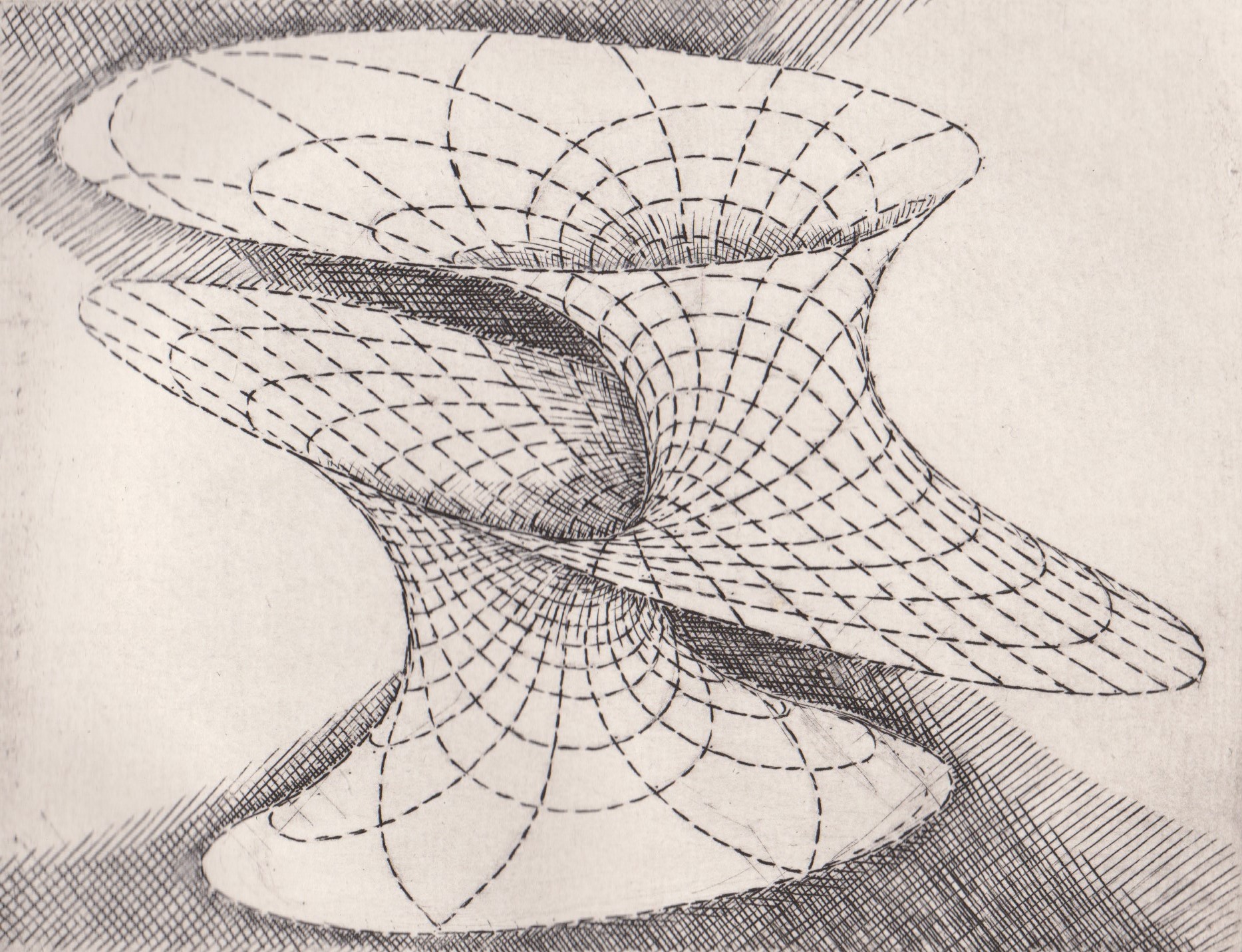
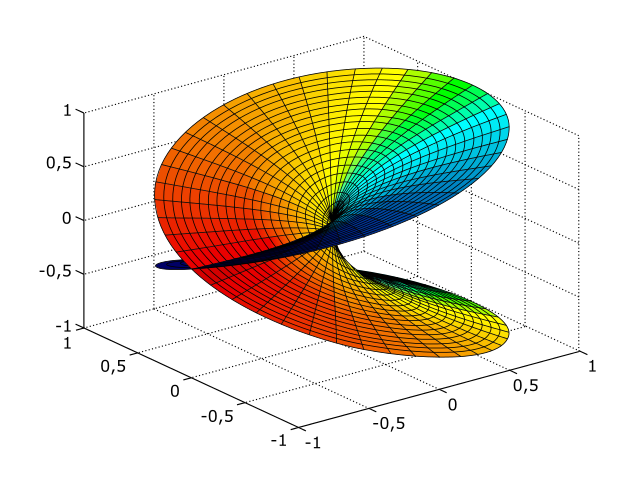
Riemann Surfaces
A Riemann surface is a one-dimensional complex manifold. This essentially means that, locally (in the vicinity of any point), a Riemann surface looks like the complex plane, but globally, its structure can be much more complicated.
One motivation for introducing Riemann surfaces was to understand multi-valued functions. For instance, the square root function is multi-valued: \(\sqrt{4}\) can be 2 or -2. To handle this, we can create a Riemann surface called a “double cover” of the complex plane, where each point has two values of the square root.
Complex Plane: This is the simplest Riemann surface. Every point has a unique complex number associated with it.
Riemann Sphere: Imagine taking the complex plane and adding a point at infinity, turning it into a sphere. This surface provides a compact way of representing the entire complex plane.
Torus: A torus can be viewed as a Riemann surface, generated by identifying opposite edges of a rectangle in the complex plane.
As one encircles a branch point, the function value might switch from one branch to another. This phenomenon, where the function’s value changes as you go around a loop, is known as monodromy. Riemann surfaces play a crucial role in various areas: They allow for the extension of the theory of holomorphic functions to deal with multi-valued functions. Complex algebraic curves can be viewed as Riemann surfaces. The study of elliptic curves, which are a type of Riemann surface, has deep implications in number theory, most famously in the proof of Fermat’s Last Theorem by Andrew Wiles. String theory, a framework attempting to unify all forces of nature, is deeply tied to the mathematics of Riemann surfaces.
Riemann’s ideas, especially in geometry, were way ahead of his time and provided the mathematical underpinning for General Relativity, among other things. His work has continued to be foundational in multiple areas of mathematics.
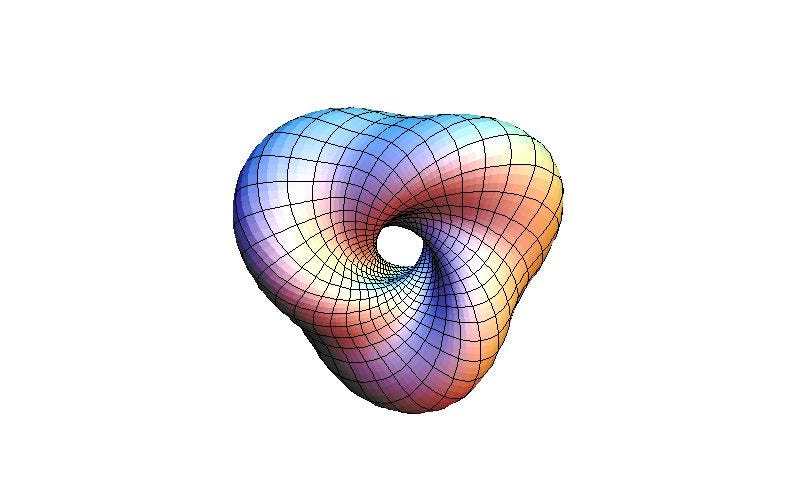
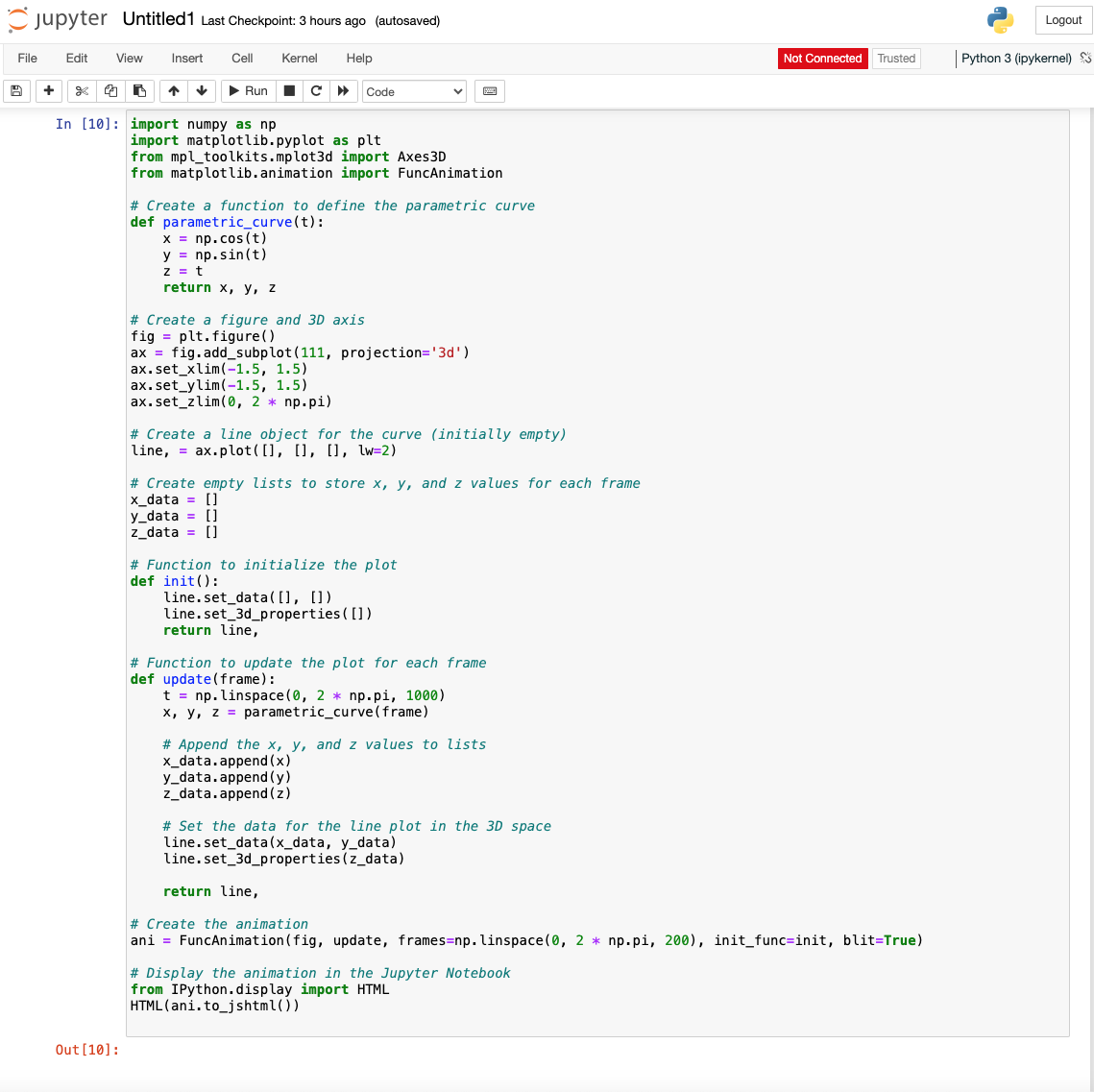
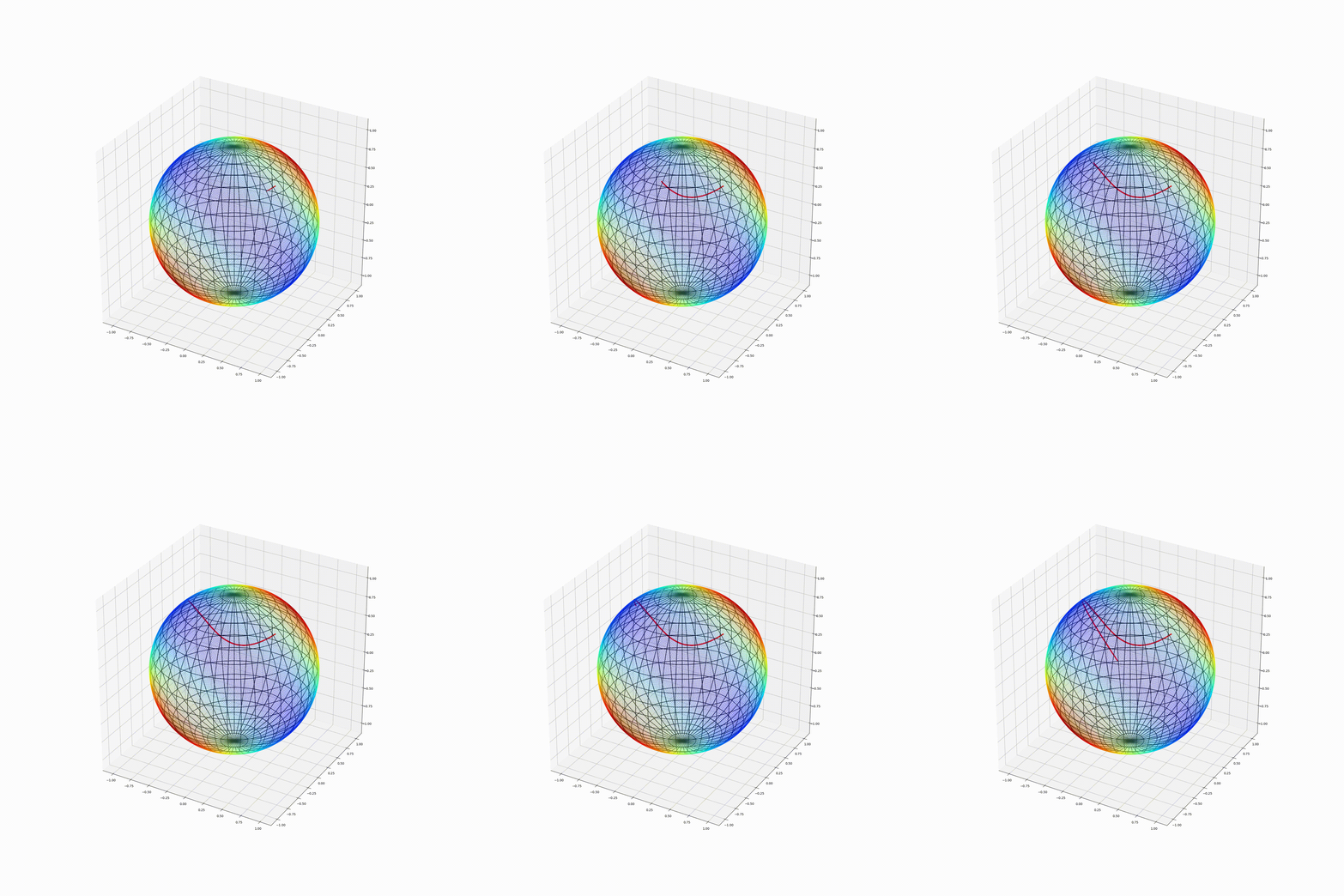
Math With Python Practicum
Chess Praxis
‘The Immortal Game’
1.e4 e5 2.f4 exf4: The King’s Gambit – a daring opening choice aiming to accelerate development at the expense of a pawn. It’s a direct challenge to Black: accept the gambit and try to hold onto the material, or decline and maintain a symmetrical pawn structure.
3.Bc4 Qh4+ 4.Kf1: The Bishop’s Gambit variation. By playing Bc4 before Nf3, White avoids immediate pressure on the e4 pawn. However, 4.Kf1 is a rare and awkward way to deal with the check, sacrificing castling rights. More common is 4.Ke2.
4…b5 5.Bxb5: Black counters with a pawn sacrifice, hoping to divert White’s pieces from the center. By capturing on b5, White’s bishop is potentially offside, but it disrupts Black’s pawn structure.
6.Nf3 Qh6 7.d3 Nh5: White solidifies the e4 pawn, while Black’s queen and knight become active, targeting White’s kingside weaknesses.
8.Nh4 Qg5 9.Nf5: White’s knight dances, first evading a capture and then hopping to a dominant central square, eyeing key points in Black’s camp.
c6 10.g4 Nf6 11.Rg1: Black challenges the intruding bishop, but White’s aggressive g4-push, followed by Rg1, reveals intentions of a kingside assault.
11…cxb5 12.h4 Qg6 13.h5 Qg5: White’s pawn thrusts start to hem in Black’s queen, while Black is keen on opening lines and trading off some of White’s aggressive pawns.
14.Qf3 Ng8 15.Bxf4 Qf6: White completes development with threats. Black, sensing danger, starts rerouting the knight to a defensive posture.
16.Nc3 Bc5 17.Nd5 Qxb2: Centralization is key. White’s knight jump to d5, combined with threats against f7, ties Black down. Black’s queen, while active, is on a dangerous pawn-grabbing adventure.
18.Bd6 Bxg1 19.e5: A tactical strike. White disregards the material loss, pushing the e-pawn to open lines against Black’s king. This move also cuts off the defensive capabilities of Black’s pieces, leaving the king vulnerable.
19…Qxa1+ 20.Ke2 Na6 21.Nxg7+: Sacrifices continue, as White tears open Black’s king position. Every move comes with a threat, leaving Black with limited defensive resources.
22.Qf6+ Nxf6 23.Be7+ 1-0: The final sequence showcases White’s dominance. Despite being material down, the active placement of White’s pieces and the impending material and mating threats force Black to resign.
Major Motif: Sacrifice
2.f4 (King’s Gambit): This is the fundamental pawn sacrifice that characterizes the King’s Gambit. By offering the f-pawn, White aims to rapidly develop pieces, especially the queen’s bishop, and create a quick attack on the f7-square. It also seeks to draw the black e5-pawn away, giving White a central majority.
4…b5: Black’s pawn sacrifice is a counter-gambit, intending to divert the white bishop from its powerful central location on c4 and disrupt White’s development. If White were to decline with a move like 5.Bb3, Black can play …c6 and …d5, seizing central space.
17…Qxb2: Black’s queen captures a pawn on b2, a common tactical motif in many openings known as a “poisoned pawn”. This sacrifice from White is more of a tactical oversight than a deliberate strategy. While the pawn grab threatens the knight on c3 and seems lucrative, it places the black queen in a precarious position and sidelines it from the defense of the kingside, where White soon launches a deadly attack.
18.Bd6: By placing the bishop on d6, White indirectly sacrifices the bishop on g1. This is a tactical sacrifice, allowing White to unleash the potential of the central pawn duo (e5 and d6). It’s especially effective because it obstructs Black’s defensive resources, making the black king more vulnerable.
21.Nxg7: A knight sacrifice aiming to pry open Black’s king’s defenses. The immediate threat is to fork the king and queen with Ne6+, and the long-term aim is to exploit the opened lines against the king. This sacrifice further emphasizes the theme of the game: dynamic piece activity and king safety over material.
19.e5: With this move, White sacrifices the bishop on g1 to pull the black queen further away from the action and open lines against the black king. White’s aim is to divert and misplace the black pieces to pave the way for a devastating attack against the vulnerable black king.
21.Nxg7+: This knight sacrifice is crucial for cracking open the defenses around Black’s king. By luring the king to d8, White ensures that Black’s rook on h8 and knight on g8 remain passive and unable to participate in the defense.
22.Qf6+: This isn’t a material sacrifice per se, but it’s a key move that forces Black to accept the material offering. It pulls the knight to f6, which sets up the deadly discovered check that follows.
23.Be7+: The final, elegant bishop sacrifice. By putting the bishop en prise with check, White clears the e7-square for the knight check, which will be decisive. The sacrifice is made possible because Black’s pieces, especially the rooks, are disconnected and unable to defend against the threats. Accepting the bishop leads to a quick mate, while declining it means dropping the queen and facing a hopeless position.
Practice
Black to play. Can you find a clever sacrifice that leads to the winning position?
A bishop and knight can be stronger than a queen! Black to play
Crafty knight play from white forces a win